
How to Spot a Bail Bond Scam
No deputy, court clerk, probation officer, or treatment program will call you out of the blue and demand cryptocurrency, gift cards, or a Zelle transfer to stop a warrant. That combination is the scam. It does not matter how much the caller knows, what your caller ID says, or how certain they sound.
What makes these calls work is timing. They land on people who genuinely have something to worry about: someone was arrested last week, someone just bonded out on a DUI, someone knows there is an old warrant floating around. The fear is already there. The caller only has to point it somewhere.
What the call sounds like
The caller introduces themselves as a deputy, a sergeant, a detective, a court employee, a probation or pretrial officer, a monitoring officer, a treatment coordinator, or a bail bond agent. They give a full name and often a badge number, a case number, or a warrant number.
Then they prove they know things. The defendant's real name. The actual charges. The bond amount. The arrest date. A court date. Sometimes the name of a real Hillsborough County deputy.
None of that proves anything. Arrest and court records are public in Florida, and so are the names and ranks of most law enforcement personnel. A scammer can look up exactly what you can look up, and they do it before they dial. Accurate information is the setup, not the credential.
Your caller ID is no better as proof. Caller ID can be spoofed to display any number, and the Hillsborough County Sheriff's Office has warned that people impersonating deputies have made HCSO's own non-emergency number appear on victims' phones. Your screen can read "Hillsborough County Sheriff's Office," show the agency's real number, and still be someone with no connection to HCSO.
Once the caller has your attention, an emergency appears. There is a warrant. You missed jury duty. Your family member is in custody. Your ankle monitor was never activated. You failed to enroll in court-ordered treatment. Then comes the amount, and the deadline.
The fake rehab and treatment version
This one is worth knowing about in detail, because it is the most convincing version going around and it targets people who just got out.
Someone bonds out on a DUI, a possession charge, or another drug offense. Days later a caller says they are with the court, pretrial services, probation, a monitoring company, or a treatment provider. The story is that a judge ordered treatment as a condition of release, the defendant never registered, and now there is a compliance fee due immediately.
You might hear that your rehab enrollment fee has not been paid, that there is a $950 compliance fee due today, or that the judge ordered treatment and you failed to sign up. Then the threat: pay right now, or a warrant goes out.
The caller may use the name of a real Tampa treatment organization to sell it. Two that come up are ACTS, the Agency for Community Treatment Services, and Cove Behavioral Health, which longtime Tampa residents still know by its former name, DACCO. Both are legitimate providers working in this area. Neither fact tells you anything about the person on your phone, because those names are on the public internet.
Courts do order substance abuse evaluations, counseling, DUI programs, and residential treatment. That part is real, and our article on DUI bail bonds in Florida explains which of those requirements come with a conviction and which a judge can order as a pretrial condition. But a real order runs through a real case: an assessment, a referral, a provider, a placement, paperwork you can look at. Someone ordered into residential treatment may even stay in custody until a bed opens up. What it does not look like is a stranger calling a week later wanting a thousand dollars through Zelle in the next twenty minutes.
The ankle monitor version
Same structure, different pretext. The caller says your monitor needs an activation payment, your monitoring account is delinquent, or the monitor was never registered, and that a judge ordered the payment today. The number is usually specific enough to sound administrative rather than made up.
Treat it identically. Hang up and check with the court, your attorney, pretrial services, or the actual monitoring company, using a number you find yourself.
Why they always want crypto or gift cards
The payment method is the clearest tell in the whole call. Scammers ask for cryptocurrency, gift cards, wire transfers, or instant person-to-person apps because those payments are close to impossible to claw back.
The cryptocurrency version usually goes like this: withdraw cash from your bank, drive to a gas station or convenience store with a crypto ATM, stay on the phone the whole way, feed the cash into the machine, and scan a QR code they send you. That code points at their wallet. Once the transaction confirms there is no chargeback, no issuer to call, and realistically no getting it back.
Gift cards work the same way. You buy them, you read the numbers off the back, and the balance is theirs before you hang up. No deputy, judge, clerk, or licensed bail agency has ever cleared a warrant with Walgreens gift cards.
"Don't hang up" is the whole scam in three words
Listen for the instruction to stay on the line. Do not hang up. Do not call the jail. Do not call your attorney. Do not call your bondsman. Do not discuss this with anyone. If the call drops, the warrant activates.
There is one reason for all of that. The moment you put the phone down and call the sheriff's office, the court, or your bail agent yourself, the story falls apart. The secrecy is not protecting you from anything. It is protecting the caller from being checked.
A real obligation survives a phone call ending. If someone tells you that hanging up triggers your arrest, you have learned everything you need to know about who you are talking to.
What real bail and real payments look like
A legitimate bail transaction has a named licensed agent, an identifiable agency, written paperwork, disclosed fees, a receipt, and an actual defendant and bond you can verify independently. Our article on how bail bonds work walks through the whole process, and Can You Pay Your Own Bail in Florida? covers posting a cash bond directly.
The jail's own procedures are a useful contrast. For cash bonds and purges, HCSO states that payment has to be the exact amount and can be made by cash or money order, that credit and debit cards are not accepted, and that those payments are made in person at the Orient Road Jail, 1201 Orient Road, Tampa. Surety bonds are accepted from registered bail bond agents. Compare that to "send me $1,200 on Zelle right now" and the difference speaks for itself.
Verify before you send anything
- Hang up. A genuine legal obligation will still be there in ten minutes.
- Do not call back the number that called you, and do not trust the number on your screen. Look the agency up yourself.
- Confirm the arrest actually happened. The Orient Road Jail booking line is 813-247-8300, and our Hillsborough County jail booking guide explains how to check.
- Check any claimed court order against your own paperwork, then with your attorney or the court directly. If a judge really ordered treatment, there is a record of what was ordered and where to report.
- Ask for the Florida bail bond license number and verify it yourself through the Florida Department of Financial Services licensee search at licenseesearch.fldfs.com (opens in new tab). O'Malley Bail Bonds is licensed in Florida under license #B000227 (opens in new tab), and we would rather you check ours than take anyone's word for it.
- Ask what the money is for, who receives it, which case it concerns, and how you get a receipt. Demands that cannot survive those questions are not real.
- Tell one other person before you pay. Saying the story out loud to a family member, a friend, or your attorney breaks the spell more reliably than anything else on this list.
Who investigates these scams in Hillsborough County
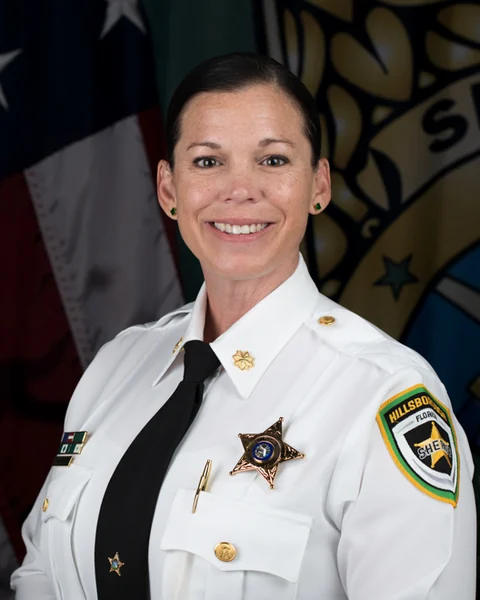
The Sheriff's Office keeps its Economic Crimes Section inside the Property Division, alongside the Auto Theft Unit, the Construction Fraud Squad, the Organized Retail Theft Unit, the Evidence Section, and the Property East and West sections. Fraud complaints, including impersonation scams like these, run through that division. It is commanded by Major Colleen Handrick.
Major Handrick is a Florida native who grew up in South Florida and studied criminology at Saint Leo University. She joined the Hillsborough County Sheriff's Office in 2002 on District 1 patrol, then served as a field training deputy and as a detective handling DIU and general offense cases before moving into supervisory roles. Before her promotion to Major she oversaw District 3 patrol and latent investigations, District 5 patrol, and the Homeland Security Division, returning to District 5 as Captain.
How to report it
Report these calls to the Hillsborough County Sheriff's Office at 813-247-8200, the non-emergency line. Say plainly that someone impersonating a deputy, court employee, treatment provider, or bail agent demanded money. If a crime is in progress, call 911.
Before you call, save everything: the number that called, a screenshot of the caller ID, voicemails, texts, emails, the name and rank and badge number they used, any case or warrant number, the payment instructions, wallet addresses, QR codes, transaction IDs, ATM receipts, and any message telling you not to hang up. Report it even if you did not send money. Your call may be the one that connects to somebody else's.
If you already paid
Move fast. Call your bank, card issuer, or payment app immediately, then report it to HCSO at 813-247-8200 with the evidence above. Recovering cryptocurrency or gift card money is unlikely, and it is better to hear that plainly than to be told otherwise.
Then expect a second call. People who have paid once get targeted again, often by someone claiming to be a fraud investigator, a lawyer, or a crypto recovery specialist who can get the money back for an upfront fee. That is usually the same operation running the same play on a known victim. Do not send more money.
Frequently Asked Questions
Will a deputy or court ever call and demand payment to clear a warrant?
No. An unsolicited caller claiming to be law enforcement and demanding immediate payment to stop an arrest is a scam, and demands for cryptocurrency, gift cards, Zelle, or wire transfers make it certain. Hang up and call the agency yourself. For HCSO, that is 813-247-8200.
My caller ID said "Hillsborough County Sheriff's Office." Was it real?
Not necessarily. Caller ID can be spoofed to display any number, and HCSO has warned that impersonators have made its own non-emergency number appear on victims' phones. Hang up and dial 813-247-8200 yourself rather than calling back what you were shown.
I bonded out on a DUI and someone says I never signed up for rehab. Should I pay?
Not until you have verified it independently. Check your court paperwork, then contact your attorney, the court, or the treatment provider using a number you look up. A judge can absolutely order treatment, but nobody collects for it by calling you and threatening a warrant if you do not pay during the call.
The caller knew my exact charges and bond amount. Doesn't that prove they are official?
No. Arrest and court records are largely public in Florida, and scammers research a case before they call precisely so the details land. Accurate information makes a call convincing; it does not make it legitimate.
They named a real treatment center like ACTS or DACCO. Is that a good sign?
No. Both are real organizations, ACTS being the Agency for Community Treatment Services and DACCO now operating as Cove Behavioral Health, which is exactly why their names get borrowed. Hang up and contact the organization directly using contact details you find yourself.
Why do scammers insist on Bitcoin?
Because it is effectively final. Once cryptocurrency reaches a wallet they control there is no chargeback process and no issuer to reverse it, unlike a card payment. Gift cards and wire transfers appeal to them for the same reason.
How do I check that a bail bond agency is really licensed?
Ask for the Florida bail bond license number, then verify it through the Florida Department of Financial Services licensee search at licenseesearch.fldfs.com (opens in new tab). O'Malley Bail Bonds is licensed under #B000227 (opens in new tab). Any legitimate agent will expect you to check.
How do I confirm someone is actually in jail?
Call the Orient Road Jail booking line at 813-247-8300, or search the Sheriff's Office online arrest inquiry by name. Our booking information guide explains what to have ready. Confirm the arrest before you discuss money with anyone.
This article is general information about recognizing fraud, not legal advice. If you are dealing with an actual warrant, charge, or court-ordered condition, talk to a qualified attorney.